
For generations, athletes have prepared for predictable opponents.
A faster defender.
A stronger opponent.
A louder crowd.
A higher-pressure moment.
Sports psychology has spent decades helping athletes develop the mental skills necessary to manage these challenges: confidence, focus, emotional regulation, resilience, and the ability to perform when the world is watching.
But today’s athletes are facing a competitor no one prepared them for:
A version of themselves that doesn’t exist.
A fake interview.
A manufactured quote.
A video that appears authentic but was created by artificial intelligence.
And unlike a competitor across the field, this opponent can reach millions of people before the athlete even realizes the game has started.
The New Battle for an Athlete’s Identity
An athlete’s reputation has always been part of their career.
A single interview can define a legacy. A controversial statement can dominate headlines. A powerful message can inspire millions.
From Muhammad Ali’s outspokenness to Michael Jordan’s carefully crafted brand, the world’s greatest athletes have understood that performance does not end when the game clock expires.
Who you are—and who people believe you are—matters.
That is why the rise of AI-generated content creates a challenge unlike anything athletes have faced before.
The question is no longer:
“How should I respond to what I said?”
The question has become:
“How do I prove I never said it?”
LeBron James Says What Every Athlete Is Thinking
Recently, sports journalist Daniel Roberts highlighted the growing problem of AI misinformation in sports, describing how fake stories, fabricated quotes, and manipulated content are spreading rapidly online.
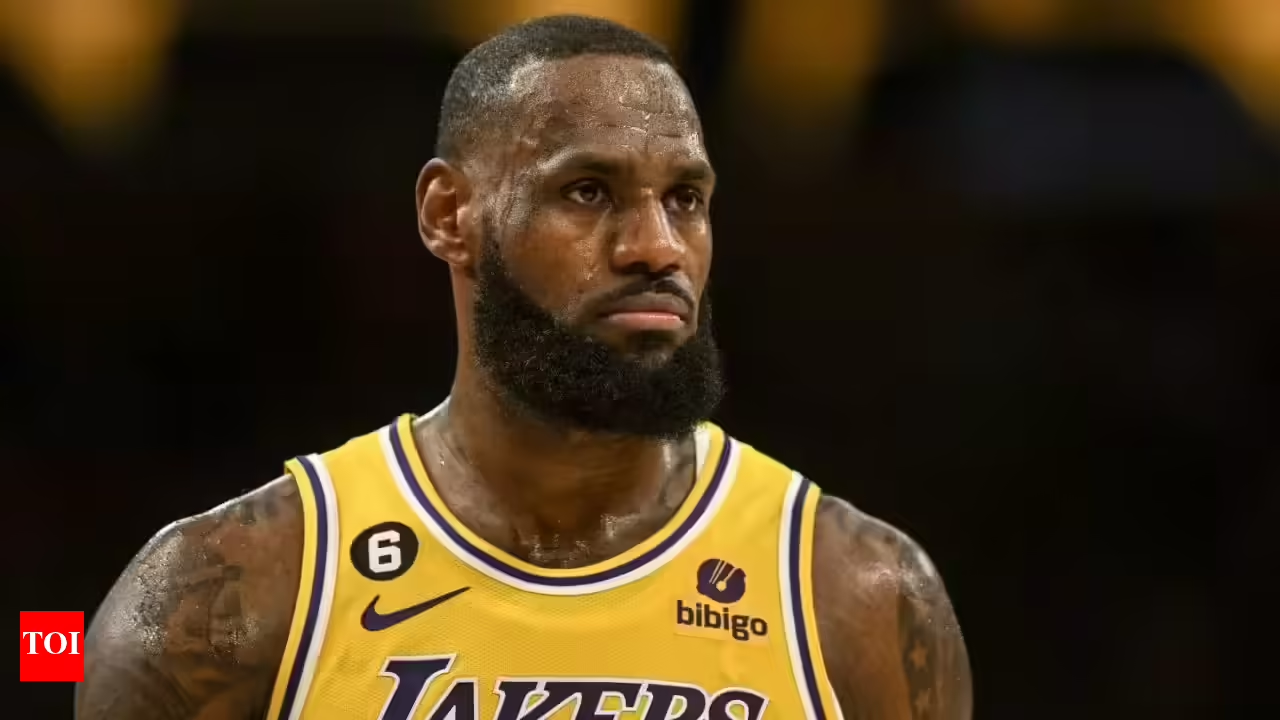
LeBron James, who has experienced the challenges of misinformation and unauthorized AI depictions of his own likeness, saw the post and responded simply:
“Ya Think?!?! 🤦🏾♂️”
Two words. A world of frustration.
The sarcasm speaks volumes.
For athletes, coaches, and organizations, AI misinformation is not a hypothetical future concern.
It is today’s reality.
And it creates a psychological burden that few people outside elite sports fully appreciate.
The Hidden Performance Cost of Constant Reputation Management
In the field of sport psychology, one of the concepts often discussed is cognitive load.
Elite performance requires attention.
The athlete standing at the free throw line, stepping into the batter’s box, or preparing for a final serve needs their mental resources directed toward execution.
Every unnecessary distraction takes away from that process.
Now imagine waking up before a competition and discovering that millions of people are debating a statement you never made.
Do you ignore it?
Do you address it?
Do you release a statement?
Do you call your agent?
Do you worry that sponsors, teammates, or fans have already made judgments?
Those decisions consume energy.
They pull attention away from recovery, preparation, and performance.
The greatest athletes in the world already compete under extraordinary pressure.
AI has added an entirely new category of stress.
This Is Bigger Than Sports
The reason this conversation matters to businesses, brands, and leaders is simple:
The same technology threatening athletes’ identities is threatening every organization’s reputation.
For decades, brands worried about bad customer experiences, poor decisions, or controversial statements.
Those threats still exist.
But now there is another possibility:
A false statement can spread before a correction ever catches up.
A fake video can damage trust before anyone confirms whether it is real.
The new challenge of leadership is not only managing your reputation.
It is defending your reality.
The Brands That Win Will Be the Ones People Trust
Technology will continue to advance.
AI will become more convincing.
Deepfakes will become harder to identify.
The answer is not to fear innovation. AI will bring incredible opportunities to sports, medicine, business, and human performance.
But every technological advancement creates a new responsibility.
In an era where anyone can manufacture a moment, authenticity becomes one of the most valuable assets an athlete or brand can possess.
Trust is no longer simply built by what you say.
It is built by consistency.
By transparency.
By the relationships you develop with your audience long before a crisis occurs.
Because when people know who you really are, they are less likely to believe a fake version of you.
The New Mental Game
The greatest athletes have always adapted.
They adapted to new training methods.
New opponents.
New technologies.
New expectations.
Artificial intelligence is simply the next evolution of the environment they compete in.
But this opponent is different.
It cannot be outrun.
It cannot be outmuscled.
It cannot be defeated with a better game plan.
It must be managed through awareness, education, and an unwavering commitment to authenticity.
The next great battle in sports may not be fought on the field, court, or ice.
It may be fought over something even more fundamental:
The truth.
